Rebecca Talbot: Essayist and Orchard and Farm Marketer

Writer picI first met Rebecca at a fortuitous holiday party in the neighborhood, when our mutual friend introduced us by saying, “You both write. You should talk.” We did talk and now I count her among the few writer friends who have seen me Pilox at Women’s Workout World. This is a testament to her kindness and grace, which is evident in all her essays and stories that I’ve been lucky enough to read.

I hope you will be as inspired as I was by her thoughtful interview about her own diligent writing practice, finding inspiration in other art forms, and how gears and gauges are like words and sentences.

What do you write? How do you write it?

I write nonfiction and sometimes fiction.  Fiction always feels like giving myself a break from nonfiction because I tend to write essays that require months of picking away at research.  But no matter what the genre is, I write slowly.  That’s probably a matter of not making as much time for writing as I could, but I also like to think the story or essay is always there with me, walking around with me, and when I spend that much time with it, I finally get to know it better and realize what it’s missing.

There was a short story I was working on for three years, off and on, and it never felt finished.  Then last January I was with my in-laws and while I was looking at a book of M.C. Escher’s artwork, I found an image that brought the story together and became central to its meaning.  Then on the flight back I was reading Zadie Smith’s essay, “That Crafty Feeling” in her collection Changing My Mind, and it made me realize some super annoying things I was doing in the story that definitely needed to go.  I revised the story again, sent it out, and Apeiron Review published it. 

There’s definitely a hidden snare, there, too: Everything can be improved, and you can’t wait forever for the right piece of information to drift along.  But I do find it comforting that if a story or essay isn’t coming together right now, I may have the resources later.

What are sources of inspiration that you return to?

Inspiration means two things to me: first, what sources tend to spark ideas, and second, what sorts of things help when I get stuck.  Social history sparks ideas.  I like to know all sorts of nutty things people were up to in the past.  I’ve been reading a lot about Romantic era scientists and poets lately.  The Age of Wonder, Richard Holmes’s chronicle of the relationships between the poets and scientists of that era, makes me want to write at least eleven books.

When I get stuck, I turn to visual art, live lit, and poetry.  I feel more inspired to write after I’ve browsed an art museum or gallery or spent an evening at the Uptown Poetry Slam.  It helps me loosen up, not take myself so seriously, and just be part of the conversation.  Poetry on the page helps too—I guess it moves me out of perfectionism and into joy.

Can you tell us a little bit about your day job and how you got there?

I’d been an adjunct for five years, up until 2013.  I loved teaching, but it took everything I had.  Weekends, evenings, and early mornings all went to lesson planning and grading.  I wrote one story during the whole five years and it was for my mom, for Christmas, because she specifically asked me to write something.  Eventually I gave up teaching and began freelance tech writing.  The projects came in bursts and between bursts I could work on projects of my own.  That was ideal for a while, and then the projects came in less frequent bursts, so I started working for my sister’s company, marketing orchards and small farms.  Right now, I am doing that and working in a university writing center, which has brought many of the aspects I loved about teaching back into my life.

How does it challenge/influence/inspire your writing life?

I love this question.  Is it okay to give a shout-out to my dad, who turns 60 this week?

Of course!

My dad will spend all day working on pharmaceutical packaging equipment, facilities maintenance, autoclaves, or whatever else he’s assigned, and then he’ll come home, eat dinner, and head out to the barn to fix old cars.  He just loves the materials.  He loves lifting large metal things on jacks.  He loves gears and gauges and catalytic converters and pumps.

I think I’m the same way about sentences and words.  I love these materials.  Any day I get to spend with the written word is a good day.  I believe that good, clean writing brings beauty into the world—whether it’s good copy for a good cause, a clear pharmacology report for a pharmaceutical company’s investigational drug, or a gripping essay in Harper’s.  The marketing job allows me to do lots of writing, and that feels fulfilling.  It is a challenge to find time to work on my own projects, and it’s easy for work to just spill over into everything.  (I work with social media.  That’s dangerous.)  Working from home several days a week is good, though.  I had been waking up early and spending a few hours writing, and my goal for October is to get back to that.

You can find more of Rebecca’s fine writing on her client’s blogs and in Curator Magazine where she inspires us with an interview with Jazz musician Ron Thomas.

Lana Spendl: On the Solitary & the Social

I had the great privilege of traveling to Nepal with fiction writer Lana Spendl a few summers ago, where we walked down streets with our professor, Samrat Upadhyay, who was constantly being recognized as the celebrity author he is. Shopkeepers would run to their nearby homes to grab their copies of his novels and ask for his autograph and how they too could become published storytellers. As we walked around Kathmandu, we discussed the nature of reality or intention–Lana is not often one for small talk. Her stories too have a richness that is above average. You can find her story “In the Bascarsija Quarter,” which was nominated for the Pushcart Prize, in The Greensboro Review Issue 91.

She recently agreed to take part in our working writers series. Once again, I’m inspired to put pen to the paper after conducting an interview. Here’s what she had to say:

lana

What do you write?

I write short stories and flash fiction. I was born in Sarajevo, Bosnia, and spent half of my childhood in Avila, Spain, due to the Bosnian war. Most of my stories take place among the churches, mosques and cobbled streets of these two cities.

I’m working on a collection of stories which takes place in Sarajevo about ten years after the peace treaty was signed. This falls around 2005, the year I last visited the city. My stories follow various men, women and children who live in the Grbavica neighborhood in a tall building that overlooks the River Miljacka. The stories portray widely different characters, from a middle-aged alcoholic man who lives with a war widow to a short-tempered female lawyer who is afraid of betrayal and abandonment. I find it helpful to write about characters who are facing challenges different than mine; this allows the characters to remain self-contained and prevents a lot of my personal thoughts and feelings from pouring into the story.

I started writing the flash pieces recently. They offered me a break from the story collection. The collection consists of highly traditional stories written in third person. The flash work has allowed me to go back to playing with first-person narrators. Also, while working with flash, I do not feel constrained by setting or style and play with any topic that captures me in the moment.

In terms of process, I begin stories with an image—although sometimes I picture entire scenes involving tree-lined streets and winds that run the leaves across the pavements—and then I focus closely on one character and record everything he/she does within this space. One action leads to another, and, in first drafts, it is the story that leads me along. In revision, I often rewrite the story from the beginning, and much of what I wrote in the first draft gets thrown out. Sometimes my characters change drastically from one draft to another. A neurotic young man in a first draft may turn into a gruff octogenarian in the second.

What are the sources of inspiration you return to?

I assume you’re asking about literary inspirations. I love Virginia Woolf, Colette, Hermann Hesse, Nabokov, and highly personal philosophical works, like Seneca’s letters or anything by Rousseau or Nietzsche. I also enjoy Russian fiction with an absurdist bent. And I love the sounds and images in Lorca’s earlier poetry.

When I think of Woolf, I think of sunlight, glittery water, rhythm. She gives the most basic elements of life meaning—I’m thinking about her essay on the moth now—and reading even a page of her writing makes me feel more involved with my own life. The Waves is my favorite novel of hers. Colette gives a preciousness to memory. I love her tender treatment of her mother and even the detailed way in which she arranges jars on a table. Nabokov’s style is powerful. Reading him sharpens my own images. Among the Russians, Vladimir Voinovich is a writer I’ve been reading religiously. Hilarious, dark, sometimes cartoonish. I also recently watched the movie Adore. Great character study. It takes place by the Australian seaside, and it portrays the sexual relationships two close female friends have with each other’s sons. The movie is subtle and honest, and after watching it, I discovered that it was based on Doris Lessing’s novella The Grandmothers. I’m reading this piece now, and there is much to admire about the way the narrator plays with point of view and space and the fascination people have with the lives of others. This kind of fascination—the projections we cast on others—is something that interests me very much.

What do you do to pay the bills?
I work full-time as an academic advisor and part-time as adjunct faculty in fiction at Indiana University. I completed my MFA a few years ago and moved into an MA program in Hispanic Literatures. After finishing it, I started a PhD in Spanish Literature. I was drawn to twentieth-century Spanish novels and poetry—they rely heavily on themes of trauma and memory—but since the PhD program was a critical one, I felt that I had to keep on mechanically deconstructing texts and language when all I wanted to do was construct. The creative and critical mindsets seemed to work in opposition to each other, and I decided to leave the program in order to have the space to write.
I was lucky enough to land a position in advising shortly after leaving the program—it was the job I wanted most in Bloomington, because it would allow me to keep on working closely with students and to remain in the academic environment—and I was offered a creative writing teaching position the same summer. I truly enjoy both jobs. They allow me to remain in an environment in which people talk about ideas, and they allow me to help students in matters relating to their education. This is a matter close to my heart. I also enjoy interacting with people all day. It compliments my writing well, since writing is a solitary endeavor and I’m a very social person.

Kate Klein: Embedded Fiction Writer

One very exciting thing about keeping a blog is living in a state of discovery. A few weeks ago, I didn’t know Kate Klein, but now after interviewing her and reading from her stories and reviews from around the web, I have found a new writer I’m excited to hear more from.

Kate & Jimmy

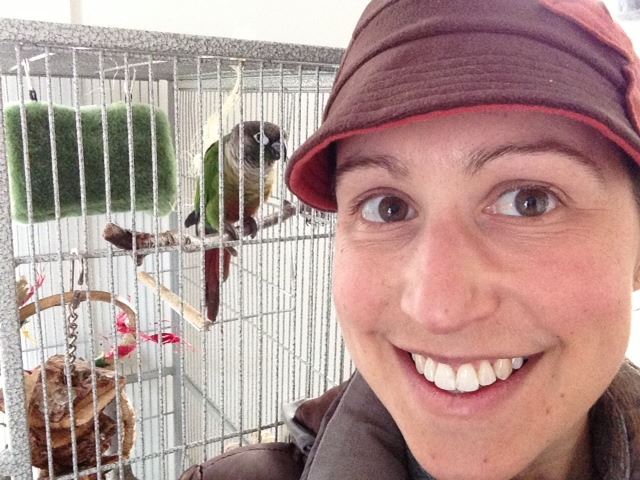
Kate and Hendrix, the parrot

She has shared with me from her experience as writer, fundraiser “virtual forklift driver” , and person living in the real world.

What do you write? How do you write it? If someone in a theater ever yells, “Is there a fiction writer in the house?” I would truthfully be able to come to the rescue—I hold an MFA in the discipline and I’ve had short stories appear in print.  My great passion is writing novels.  One, my MFA thesis titled The Fifth Voice, is resting before a full re-write and another, Eternal Girl, is just about ready to emerge into the “publish me!” world.

I started my career as a journalist, working as a daily newspaper reporter and editor.  Lately, I’ve had a few magazine article assignments, which I’ve enjoyed a lot.

Every weekday morning, I get up early and write for two hours.  Morning has always been my best creative time. At 8:15 or so, I pry myself away from my desk and walk to Cornell University, where I work for the alumni affairs and development team for Johnson, the university’s business school.

Tell us about your day job and how you got there.  How does it challenge/influence/inspire your writing life? My title is “development assistant,” but that’s not very descriptive; at parties, I tell people I work as a ghost writer and spy, and they understand a lot faster.

My team’s job is to bring money in to fund the business school.  My colleagues go out on the road to ask alumni for generous donations.  They are awesome at what they do—my supervisor nabbed a $10 million gift this quarter. My particular job is to support the road warriors with my writing and research skills, and by manipulating an enormous database, a task akin to driving a virtual forklift through an online warehouse.  After five years in positions similar to this one at Cornell, I’m getting very good at driving the virtual forklift.  It brings out an analytical, problem-solving side I didn’t know I had when I chose English as a college major.

My day job started out supporting my writing life.  The best benefit Cornell offers employees is free classes.  Once hired, I took writing and literature classes that helped me get into an MFA program.  After I finished grad school, however, I went back  to work full time, partly for the money, but partly because I write best when I’m engaging with the world every day.  Right now, for me, “engaging with the world” means going to work, even on the days (and there are many) when I would rather keep working on my novel all morning.

When I get grumpy about a full day in an office, I look around at the other human beings in there with me.  They are by far the most beautiful, saddest, funniest things in the gray, windowless, fluorescent-lit office.

I certainly envy writers who can write full time, but the world needs fiction writers and poets with day jobs, too—especially day jobs that have nothing to do with writing or teaching writing. The world needs writers “embedded” in the medical field and Wall Street and insurance, I think. William Carlos Williams worked as a medical doctor.  Anthony Trollope worked for the postal service.  Charles Ives (a composer, not a writer) was an insurance executive who wrote amazing music, too.

What sources of inspiration do you return to? The people I know well inspire me—besides family and friends, this includes my work colleagues.  Spend enough hours in a small space with someone and soon I start wondering, “why does he do that?  What is she really thinking?” and often, a story is born.

Music and other art forms inspire my writing, as well, but not always directly, although my first novel is about a family of musicians.  Rather, I seldom come away from a live concert or an art exhibit without scribbling lots of notes, and often those notes turn into stories or enhance a story I’m already writing.

I want to write from life in the way visual artists draw from live models.  The more I observe, the better I know my species.  And the better I get to know my species the funnier we call look.  Life has a deep, rumbling laughter underneath it, which bubbles up in the work of Robertson Davies, Flannery O’Connor, Mozart, and Jennifer Egan, to name a few.  If I capture a little of that laughter or even hear it, it’s been a good writing day.

Do you ever go to specific places with the purpose of human observation in mind? 

I don’t go anywhere to specifically observe human behavior–I just see it everywhere! From the years-long tensions I observe playing out in my own family to random encounters in a shop or on the street, I see people operating in dissonance and harmony every day.  For instance, last weekend I walked through the supermarket produce section and saw two big college boys holding a five pound bag of organic carrots between them, one saying: “So that’s twelve carrots a day.”  I have no idea what they were talking about, but I scooted on to the frozen foods isle laughing to myself.  Sometimes I have to keep to myself on purpose because my observation deck goes into overdrive and I have to seclude myself to actually write anything down, let alone shape a story out of any of it.

#

Follow up with Kate Klein on her blog, Zucchini Me.

Beth Navarro: Insight into the Active Life

Beth Navarro is a writer: she writes for her comic mom blog, Mother-naked. She writes picture books for kids. (Her debut picture book, Grambo, will available in less than a week!) She is writing a YA sci-fi novel. And she spends her job-time writing and editing marketing material. Originally from Illinois (currently the state I live in), she now lives in California (the state I’m originally from). Besides having the a few ideas about the work-life-balance thing figured out, Beth seems to have also figured out the optimal migration pattern. I still have a lot to figure. Luckily, she took a moment to share with us a few insights about how a full life has lead her to a more prolific and inspired writing life. So on to the the interview!

What do you write? How do you write it? 

I write children’s books, anything from picture books to the young adult manuscript that I’m working on right now.  I also write a blog, Mother-naked, about my adventures in parenting. My first picture book, Grambo, is out March 26th on Amazon! Grambo is about a boy who discovers his grandma is not your average grandma. She’s a secret agent! Grandmas rock.

I usually write in long stretches on the weekends. I set up camp on the couch. For some reason the couch is really my spot even though I have a desk that I love. My notes spread out on my left, my laptop on my lap and my tea and snacks on my right. Snacks are important. Working all day I rarely have the energy to write at night. I sneak in time when I can. Truthfully I don’t really let a day go by without writing something. My day does feel off if I don’t. Having less time (job, family, life) I think I am actually more prolific then when I had no kids and worked at a restaurant a few nights a week. Wow, all that time seems so luxurious now that I don’t have it. Since I have a finite amount of time, I really make the most of it.

What are sources of inspiration that you return to?
My two daughters provide endless amounts of inspiration. And books. I can always count on a good book to fill my imagination well. But the one thing that always drives me (and boy is this going to sound cheesy I think) is the idea of connection. It’s such a basic human need that I think we humans struggle with. It’s a theme that comes up in nearly everything I write.

Can you tell us a little bit about your day job and how you got there? How does it challenge/influence/inspire your writing life?

I write and edit Medicare marketing materials for a health care company. A friend of mine recommended me for the job and it’s been great! I must have an affinity for the senior Beth Navarrocommunity seeing that my first book is about a kick butt grandma and I work on medicare. I love that parallel. It is challenging having a day job, because I can’t devote every moment to writing. But I also think it’s a good thing. It forces me to dedicate certain time to writing. It helps me to really focus on one thing at time.

To learn more about Beth Navarro and where to find her work, check out her website. While there be sure to check out her logo, created by one of her daughters, and tell me that it is not one of the best logos ever.

Paula Carter, essayist, fiction writer & freelancer: Making it all fit together

Paula_CarterPaula Carter and I met in Samrat Upadhyay‘s backyard; he had invited a handful of former students over for lunch to catch up and gossip about the affairs of the University. Samrat was feeling nostalgic, I believe, as most of his students move on from Bloomington every three years and just wanted to check in on us. Though Paula and I had both been students of Samrat’s at Indiana University’s MFA program, our tenures in Bloomington had not overlapped. Over lunch of delicious Nepali food, Paula and I discovered that not only did we both live in Chicago, we lived in the same neighborhood. We swapped contact info, and so started a new friendship…which often involves me picking Paula’s brain for good ideas. Beyond being a professional writer, fiction writer, and essayist, Paula is a master craftswoman (she makes jewelry and mobiles and refinishes tables) and is adventurer (she’s ready for a triathlon or to go Sup’ing in Lake Michigan or square dancing at Old Town School of Folk). I hope you will find her recent interview as inspiring for your creative life as I do.  To read some of her work head over to the Rumpus for a thrilling essay on margarine or check her professional website.

So what do you write?

Currently, I write both professionally and creatively.  As a professional writer, I freelance and work primarily with nonprofits to create development and fundraising pieces (think high-end grant writing).  I also work with a few magazines and marketing companies.  Creatively, I write narrative essays, short shorts, and fiction.  I’m currently working on a book of very short narrative nonfiction essays.

What are your sources of inspiration for your creative writing?

I have moved so many times in the last ten years and every time I pack up my many shelves of books and cart them along with me and wonder if I should let them go, or at least a chunk of them.  I know people who pass a book along as soon as they finish it, wanting it to find another reader and wanting to clear out the clutter in their lives.  I have the opposite problem: if you lend me a book, you may never see it again.  Most writers are book hoarders, I’m sure, and I am one of them.  Also, book klepto. There is something comforting about looking at a serious stack of books. My heart rate goes down.  Not long ago, I decided to stop feeling guilty about not cleaning out my book shelves and just accept that these books were going to travel with me through life.

I have not yet purchased an e-reader.  It is the physical object of the book that gives me joy; all the pretty colors and weighty titles lined up in a row waiting humbly.  I remember hearing Ray Bradbury talk about writing Fahrenheit 451 at the UCLA library at the 10 cent typewriters.  He would write for half an hour (that is how long 10 cents got him) then run up the stairs into the stacks, pull out an old book and take a deep whiff.  He said that old books smell like nutmeg and some foreign land.  Afterword he would return to the typewriter, put in another dime and keep going.

Theater is my other great love.  One of the things I appreciate about it is that it is collaborative.  Theater requires so many different people and ideas and creative minds to make it come to life.  I recently went to see The Little Prince at the Lookingglass Theater in Chicago.  The level of creativity and imagination at that theater is unbelievable.  If you aren’t familiar with the story, one of the main conflicts involves baobab trees which grow too big and threaten the Little Prince’s small planet.  Rather than use pieces of the set to represent the trees, each time a new tree sprouted an actor’s hand would shoot up through the floor of the stage. It was surprising, funny and fresh. I thought about it for days.  Who came up with that?  When did they decide it would work and who made the floor that allowed hands to break through it?  Being stuck inside my own mind and bumping up against my own limitations can be one of my biggest struggles when writing—in theater there is play and room to experiment before a decision is made.  It reminds me to let go more in my work, have fun, share it with others.

Just going to a show inspires me.  Here are these actors giving it their all for this one ephemeral moment, this one night with this one audience.  When it’s done, it’s done.  For it to come back to life, they have to start the work all over again.  There’s a lesson there somewhere.

Can you tell us a little bit about your day job and how you got there? How does it challenge/influence/inspire your writing life?

I have been reading Ann Patchett’s new collection of essays This Is the Story of a Happy Marriage. The first paragraph of her introduction says:

“The tricky thing about being a writer, or about being any kind of artist, is that in addition to making art you also have to make a living.  My short stories and novels have always filled my life with meaning, but, at least in the first decade of my career, they were no more capable of supporting me than my dog was. But part of what I love about both novels and dogs is that they are so beautifully oblivious to economic concerns.  We serve them, and in return they thrive.  It isn’t their responsibility to figure out where the rent is coming from.”

Oh, to be a novel or a dog.  Patchett puts her finger on what I think it is the biggest struggle for creative people. I have had periods in my life when I had plenty of time to write and usually during those same periods worried constantly about what I could and could not afford.  Then, I have had times when I made a good salary and all those worries were relieved only to be replaced with uneasy and unsatisfied feelings that quickly led to anxiety and disappointment in myself.  Not a good combo.

Most people struggle to find the right work/life balance.  But artists must struggle to find the right work/life/work balance—this seems wholly unfair to me. For Patchett, she tried waitressing and teaching, before settling on freelance writing to pay the bills while she wrote her first few novels.  I have had a similar path (minus the waitressing and the first few novels).

Currently, I am a freelance writer.  I’ve been freelancing fulltime for about three years.  I decided to freelance—rather than work 9 to 5—as a way to have more flexibility, so I could also work on my own writing.  In many ways this has been effective.  I do have considerable flexibility and have been able to focus on my own creative projects in the last few years, in addition to making a living.

However, it has not been without its challenges.  The first year I made $8,000 and lived with my parents. After a few years my income has increased but I have discovered other drawbacks.  All of my work—both my own and professional work—is solitary. At times, I greatly miss working with a team.  As a freelancer, you are primarily on the outside of the action, creating content for one event or article or report, submitting the piece, making some edits and then moving on.  Additionally, when I have deadlines that other people are relying on, it can be hard to continue to set time aside to work on my own projects. No one is depending on them.  It takes real effort to continue to make them a priority.

But, really, I can’t complain. Every job has its issues and every artist has their own struggle to figure out how to make it all fit together.  For the most part, I feel pretty lucky.  I have yet to finish my “first few novels,” but I have almost completed a nonfiction manuscript I have been slowly and steadily working on.  And my cat, oblivious to economic concerns, is in love with this way of life.  I am home all day.  

Geoffrey Hilsabeck on two equally impossible pursuits.

Geoffrey Hilsabeck

Geoffrey Hilsabeck

Geoffrey Hilsabeck is a poet and essayist and English teacher at boarding school on the East coast. A graduate of the Iowa Writer’s Workshop for poetry, he has a chapbook published with Song Cave; it is sold out, but lucky for us, the press allows readers to download a copy and discover Geoffrey’s prosey and poetic investigation of “elegy to energy and back again” in Vaudeville (or as Geoffrey describes, a look at “how Americans entertained themselves before television.”)

I recently asked him a few questions about his writing life and teaching at a boarding school…

What do you write and how do you write it?
I write poems and essays, mostly in the morning. How do I write–I’m not sure what you mean. Will you clarify?
I mean…say a little bit more about when/where you write and revise? Utensils used?
I write pretty much only in the mornings: I wake up at six, make coffee and a bowl of steel-cut oatmeal, and write until it’s time to go to class or take the dog for a walk. Not having as much time to write has changed my approach to revision, since I just don’t have the luxury of obsessing over lines and sentences the way I used to; that being said, writing and revising are pretty much one and the same for me.
I like Mead composition books, which I get for free from the school store, and non-mechanical pencils; the German company Kum makes an excellent pencil sharpener, although one of these days I’m going to invest in a wall-mounted one. I avoid typing anything into my computer for as long as possible.
What can you tell us about your day job?

I teach English at a boarding school, which is a day and night job. Surprisingly, though, boarding school life does allow for some writing, since I don’t have to waste any time in the car commuting. I love teaching. I’m fascinated and frustrated by it in much the same way–or to the same degree–as writing; to me, they are very different but equally impossible pursuits. Writing is pretty solitary, of course, and so the intense sociality of teaching provides a nice complement to that. I don’t think I’d be happy doing only one or the other, although I do wish I had more time for both.

I don’t hear much about boarding schools these days. I must admit I think of Dead Poets’ Society and Catcher in the Rye— do either of these share anything with your experience?
Boarding school…it certainly looks a lot like Dead Poets Society, but the demands on students these days make for a rather different lifestyle. Also, students seem a lot happier than the characters in Dead Poets Society and Catcher in the Rye. (Perhaps the two are related?)
What inspires you as writer?
I suppose I take inspiration from what I read, mostly, I think–but who knows, really–is it reading that moves me first to write. I am moved to write by, what, feelings maybe? Less happiness and sadness though than wonder and fear. And love, of course. Is curiosity a feeling?
Yes, I think curiosity is a feeling. What are you curious about lately?
I’m still very curious about how Americans entertained themselves before television (hence the essay “Vaudeville”). I’m curious about outer space. I’m curious where poetry can take me, psychologically and spiritually.

Julia Green, novelist & freelance writer, describes the complex whole.

Image

The View from Julia’s desk

So it’s been an embarrassing long time since my last installment of 5-9, but I’m happy to tell you, 5-9 is back! So look forward to more interviews from more writers in 2014!

Today’s guest: Julia Green. I met Julia at a library to discuss the nuances of English according to the College Ready Standards. We were both working at an academic company writing and editing curriculum. Since then Julia has moved away from the great city of Chicago to a warmer climate, but we still occasionally trade emails to debate SSF versus COU. For the record, WC 24-27.3 is my favorite to write. Before becoming a curriculum guru, an ACT & SAT tutor, and freelance writer, Julia was at Iowa Writer’s Workshop for fiction. She recently finished a novel that I’m looking forward to reading someday.

I asked Julia to participate in my survey of working writers and this is what she said:

I find that desperation is the greatest source of inspiration. If I haven’t written in a while, or if I find myself in a job or a place that bores me, I disappear into my work. Or if I’m short on time, I rush to work during what little free time I do have. Every night I look at my calendar and see when I can write the next day and then I do. Because if I don’t write enough, I turn into a monster. Writing is like breathing; when I don’t do it, it can be fatal (or homicidal, if you take into account my husband, who is at the whims of my days at the desk).

Tell us a little about your day job.

Day job? More like day jobs. “Freelance writer” is a phrase that some people consider with envy and optimism; five years out of grad school, I have cobbled together enough projects that most months I end up OK. The uncertainty of contract employment is both invigorating and terrifying. There are days when I think I should chuck it and get a full-time, salaried position, but I tend to wither under those circumstances. I’m at my most productive when I’m doing a million things. There’s a whole novel in all the random jobs I’ve had in the last ten years, which means for now I’ll keep that menagerie to myself. What I can say is learning when to say yes and when to say no is invaluable. I almost always say yes, and having made good friends and contacts along the way has been an incredible asset, but every once in a while something comes along that smells off, and you know to graciously decline. And yet even the crappiest jobs I’ve had have produced something valuable—a friendship, a character, a detail, etc. As an artist, it’s hard to win the moneymaking game—whatever you do will not pay enough nor give you enough time for your work, and yet you’ll nearly always say yes and hope for a different outcome.

Do you have a link to your work you’d like to share with our eager readers?

Unfortunately, I am next to nowhere on the internet; I recently completed a novel (presently seeking representation), which I would not have been able to do had I been immersed in social media and the like. I am the most boring person at the party to talk to because whatever thing you are discussing that you saw or read on the Internet, I can guarantee you I have never heard of, but this habit allows me to get a lot of work done. When I do look at the internet, I find it very dull. With the exception of cats. If I am having a particularly bad writing day, mere minutes of cat videos will soothe my soul and re-center me. It’s not as glamorous as having a drinking problem, but it’s a lot cheaper and safer. Now that I’ve established myself as a sanctimonious Luddite, I can say that if and when my book is preparing to go out into the world, I am committed to transforming myself into a hilarious, winning, responsive, admired Internet Voice. Just as soon as I find the book at the library that tells me how to do that.

So I just googled your name to see what I could find on you: turns out there are quite a few of you, some artists and writers, and even an elementary school with your name. The only You I could find was your tutor profile. It says you tutor math as well as English…how’d that come about?

There can be a tremendous beauty and satisfaction to tutoring math: there is always an answer. And I still feel the thrill I did as a 12 year old when I do a math problem correctly: “Huzzah! I know the answer!” We all need and love the shot of dopamine that accompanies ‘I got it right.’ There’s an elegance to math, to a clever problem and the process of unraveling it. Teaching math has made me a better person–it forces me to clearly analyze and ascertain all moving parts. You cannot fudge math the way you can fudge a scene ending or even a word choice. The numbers don’t lie, don’t allow you to lie to yourself and neither does the 16 year old kid across from you who needs a clear explanation. Part of writing is fighting to get to the truth. Math can be a relief that way–it’s easier to get to the truth with math. (And when it’s not, there’s usually a smarter person around who’ll explain it to you.)

While seeking representation, do you send out sections of your novel to literary magazines?

I don’t. When I was in grad school, I sent short stories to magazines, so I’m not averse to it, but it didn’t feel right for my novel. I learned a tremendous amount in graduate school, but I also came out a bit raw. To write this book, I wanted and needed to go to a very quiet and very private place — a place where there weren’t the voices and comments I received in grad school. So I kept it away from the world, which was truly the right decision for me. Now that my book is done, I doubt I will adapt it for submission in shorter parts to magazines. Now that I’ve written a novel, I look back and see I never was and never will be a short story writer–every story I conceive of is gaping and hardly containable. (My novel contains elements of just about every story I wrote in grad school.) I suppose I approach novels as I do human beings: none of them deserve to be reduced to or identified by their disparate parts. They are complex entities best swallowed whole.

Thanks Julia for sharing a snippet from your work and writing life. As with all past interviews, I feel rather inspired to get down to work.  Good luck placing your novel!

Poet and Copyeditor Sarah Suksiri on Finding Creative Challenge

Poet Sarah Suksiri can be defined by grace–she crosses the street with grace, she offers insight into conversation with graceful, well-chosen words, and her poems are also grace- and wonder-filled. Once, I witnessed Sarah crash her car gently into an A/C unit with grace (which she also managed to un-dent with a swift kick). If you have not yet been graced with a Sarah Suksiri poem, you can listen to her read three poems here.

A little while ago, I asked her about her new job as a copywriter and her life as poet. This is what she said:

In the past two years I’ve started noticing a pattern. A lot happened — marriage, moving, graduating, moving again, several jobs. Whenever one of those changes occurred, there was a spike in my writing. So I think change and movement play an important role in writing, which, if you think about it, is usually either about revisiting the places we’ve left or trying to discover where we are now. For me, getting too comfortable generally kills my writing.

In those moments of change/realization, I write poems. Revision’s role in my writing is primarily manifested in the ever-present question, “Is this any good yet?” But beyond that, I don’t apply a very empirical revision method.

So, tell us about your new job

I have a job I love at a creative agency, where I write copy. Any full-time desk job presents a challenge at the end of the day when time and brainpower are running on reserve, but what I like about being a copywriter (besides being paid to play with language) is learning how to approach writing strategically. You sit down at your desk, and people expect results by the end of the day. It’s hard, sometimes, to expect that of myself. I read somewhere that Salman Rushdie credits his years as a copywriter for helping him develop good, professional writing habits.

I know your path to this particular agency wasn’t quite smooth. Can you tell about that journey ?
 I looked for teaching jobs out of grad school, but nothing materialized. I stumbled into copywriting from a critical, editorial, creative, and journalistic writing background, and copywriting seemed like a terrific fusion of those experiences. With that goal in mind, several months of job applications and a little bit of desperation led me to take a copywriting job that wasn’t right for me (I felt there was a lack of creative challenge and direction), but in hindsight, it opened doors and taught me so much of what has led me to a good job in a good place with good people.

You can follow Sarah on Twitter at @ahoysarah, and you can find more of Sarah’s work in lit mags in print and online– like this poem entitled “How to Write a Poem” that was published in Punchnel’s.

Poet Elizabeth Hoover on big projects, collaboration, and hard work

Hoover in a performance she created with her sister, artist Dorothy Hoover.

Hoover in a performance she created with her sister, artist Dorothy Hoover.

When I moved from Los Angeles to Indiana, Elizabeth Hoover is one of the first people I met. As she helped me adjust to life in the little town, pointing out the good vs. sketchy grocery stores, and where the most beautiful parks were located, I got to know how hardworking and well-read Elizabeth is. She is the kind of friend where your conversation easily spans from summer reading lists and bike maintenance to museum recommendations or the latest discovery on mars. If she cooks dinner for you, she will use the finest local foods using a recipe she got from an obscure magazine, and when she writes poetry, she will draft and draft and draft until she unearths magic.

I am excited to share her interview with you today. In it she shares both about her writing process, her current projects, and why she sought out a salaried job when she was working as a successful freelance writer. For this interview, I decided to start with the job-related questions and then move on to juicy writerly details. Enjoy!

What do you do to pay the bills?

I am the Assistant Director of the Furious Flower Poetry Center at James Madison University. I had been a freelance writer for some time and I would say a successful-ish one, but I was tired of always worrying about money and of re-applying for my job every day–which is what freelancing felt like. I find I am very productive even though I don’t have as much free time because the free time I do have I am not stressing out about money. JMU in general and my department in specific are very supportive so I can take time off to write. I get 20 days of vacation! Some days I write grants all day, but some days I get to learn about poets and read poetry and that’s good.
When you applied for the JMU job were also looking for teaching? Do you see any advantages to working on a campus?

 I did also apply for teaching jobs. I never heard back from any of the places I applied to teach at. I don’t know if I will pursue professorships in the future. Since I just got here, I am not really thinking about what’s next! Being part of the academic community is helpful mostly because it gives me access to a lot of resources through the library. I  have unlimited access to books and other scholarly material.

Now, tell us a little bit about what you write, how you write, and sources of inspiration you seek out regularly?

When not working with index cards I use huge notebooks that sometimes get wet

I write poetry and enjoy working on big projects like series that have a conceptual or research element. For example, I am working on a series of prose poems in the form of letters about sexual assault, how women are silenced in the academy, and ways that art can offer opportunities for healing. They rely on personal narrative but also art history and aesthetic theory. I’ve also been writing about women in pop culture, which is new for me because usually I don’t like pop culture poems. But I’ve been enjoying applying the visual analysis skills I gained as an art critic to pop culture. I am also working on a series of poems about an archive with an infinite collection of objects, including living creatures and artifacts from imaginary historical incidents. These poems enact my own obsessions with information, research, and historic material. I like to write in the mornings before work.

I live only 10 minutes away from my office so I can get up at 6:45 and get at least an hour and a half in before I have to hop on my bike. What I usually do is read for a little bit and then work on a low-stakes poetry exercise. I recently moved from Pittsburgh to Harrisonburg and my writing partner from Pittsburgh and I exchange poetry exercises every two weeks. I hate poetry exercises because they force me to go off my plan and try something I wouldn’t normally do. So I actively seek them out. After the exercises, I’ll get to work on the project poems. I also  keep little stacks on index cards everywhere–next to my bed, on my desk at work, in my pannier bag, my purse, my car–so I can jot down things as they occur to me. I don’t know what I am going to do with those cards yet. I got the idea from reading Roland Barthes’ “Mourning Diary.”

My sources of inspiration have always been pretty heterogeneous. Anne Carson is a poet I return to a lot because she also combines other discourses (history, philosophy) into her poems and her poems can straddle the line between poetry and essays. Another book that has been really important to me is The Rape Poems by Frances Driscoll. I think it’s her only book, but it’s a knock out. I read pretty much constantly because I’m also a poetry critic for the Minneapolis Star-Tribune. I read about five books of poems a week. So recent books I’ve reviewed that I found inspirational/interesting/challenging: Sarah Fox’s First Flag, Lightsey Darst Dance, Heid Erdrich’s Cell Traffic, and Sun Yung Shin’s Rough, and Savage. My non-work-related book right now is Mary Jo Bang’s translation of the Inferno, but I’m not sure I like it.

Anabel Chong perhaps killing her porn persona

“Anabel Chong perhaps killing her porn persona”


I’ve been pretty obsessed with Feminist Frequency recently as well as with horror movies, copshows, and women in pop culture like Coco Austin and Annabel Chong. (So, yes, I have written poems while watching gangbangs. It’s really awful, but I feel like it’s important for me right now to lean into the things I find disturbing and terrible and sad about the way women are treated.

Hamilton collaborates with slugs

“Anne Hamilton sometimes collaborates with slugs”

A HUGE source of inspiration for me is visual art. I am constantly taking photos in museums(since we don’t have museums here!) or reading art books. I always have a note book with me in a museum. Artists I love are Francis Bacon, Gerhard Richter, Anne Hamilton (I just saw an Anne Hamilton piece that included a vitrine with cabbages being eaten by slugs!), and Louise Bourgeois. Right now I am working on some poets based on Jindrich Heisler photocollagethings. It’s also enormously inspirational for me to read about artists’ processes. For example, seeing the film “Richter Painting” gave me a sense of freedom about relying on instinct rather than intellect. Also I try to write like Daft Punk says they play: “to the very edge of my ability.”

However the MOST important artist in my life right now is my sister Dorothy Hoover,with whom I have collaborated on a performance and a chapbook. She really inspires me because of her conceptual approach.

Thank you, Elizabeth, for sharing with us about your journey as a writer and for letting us in on what you are working on now. I am excited to read your newest poems! You can find more about Elizabeth and order her beautiful chapbook at her website!

Adventures with Poet Christopher Citro

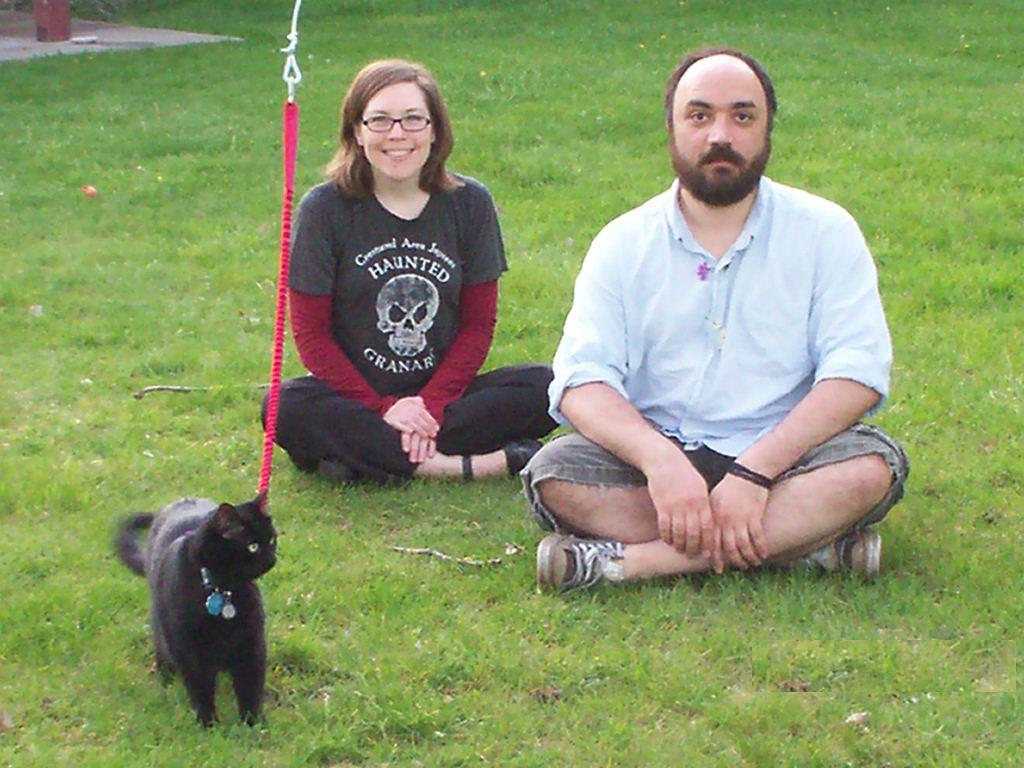
Sarah, Chris and thier cat in the backyard

Sarah, Christopher and their cat in the backyard

I wanted to find a way to celebrate National Poetry Month on my blog,  yet it is April 17, and this is my first post. Luckily, this post is a celebratory one! It contains an awesome interview with Christopher Citro, who lets us into his rigorous writing life and adventurous temp jobs in Syracuse, NY.

Christopher is friend and colleague from Indiana University. I had the pleasure of first meeting him on a road trip from Bloomington, IN for Chicago for AWP. In Chicago, as I remember it, Christopher fortuitously ran into a long-lost cousin on the sidewalk. In all workshops, classes, lectures, and rooms where I saw Christopher again surprising coincidences were often unfolding. On his website you can find his full bio and links to his published works. I encourage you to check it out, because coming to the last line of a Christopher Citro poem is waking from enjoyable dream–you want to linger in the enthralling imagery and emotion, the depth of imagination and humor. One reading, one poem is never enough.

In the following interview, Christopher gives us a snapshot (in words and photos!) of his life and a great deal of insight in to a writer’s life, temp jobs, and empathy as underlying force of poetry.  Interestingly enough, this interview provides a great contrast to last month’s interview with Naoko, and like all the interviews so far, its inspiring. So read on, dear reader!

Can you tell us a little bit about what you write? or how you write? Are there writers you return to or other sources of inspiration you seek out regularly?

I write poems. Or I try to, at any rate.

To speak concretely, I’m currently at work on poems for my second manuscript. (My first, The Maintenance of the Shimmy-Shammy, is still unpublished, but why wait?) After leaving graduate school two years ago, my partner Sarah and I spent five nervous months living off our savings in an apartment above Main Street in a small southern Ohio village near my family while we waited for one of us to get a job to take us somewhere. With nothing but free time–and Amish buggies clopping by at 4 a.m. outside our windows–I thought to myself, if I don’t use this opportunity to get into a serious post-MFA writing groove then I’m a fool.

So I did. I set up a regular morning writing schedule along with my pint of Darjeeling. I sat in a window, listening to Lee Morgan’s 1966 album The Rajah on my headphones, and writing for an hour two each morning. This ended up being one of the most fruitful writing periods in my recent life and produced the bulk of the poems which are forming my new manuscript.

I also made a writing webpage for myself. I debated doing so for weeks, as it felt kind of silly and narcissistic at first, but I’m glad it did it. If you’re not teaching, it can be hard for editors and people to find you. I’ve found that a webpage for my writing has helped me with receiving solicitations and making connections with fellow writers over the last couple years that I don’t think I could have done otherwise.

In addition to Darjeeling tea, and Lee Morgan’s jazz, my other sources of inspiration included the life of the town outside my window, the golden slide of summer into autumn, and a revolving selection of poems which I’d dug out of some of our moving boxes for inspiration. I leafed through recent copies of Indiana Review. John Berryman’s The Dream Songs was a major companion, especially for his speed and sense of rhythm and movement down the page. I started reading the poetry of Matthew Zapruder and Tony Tost, along with old favorites like Wallace Stevens, Jim Harrison, Mary Ruefle, and D. Nurkse.

Since moving to Syracuse, where Sarah eventually found a job, I’ve continued working on my second book, revising the poems begun in Ohio, creating new ones, and listening to the poems as they suggest what shape the book as a whole might eventually take. It’s a rather inchoate thing right now. And I think that’s good for now. My Ohio poems are a pile of throbbing stem cells, only just beginning to specialize into the organs and systems of a new book. And I keep making new ones to add to the heap.

When you write in the mornings for two hours, does that include revising poems, or only generating new material. Do you have  favorite time of day or regimented way to make sure you are sending out your poems to magazines?

The simple answer is: when I’m writing I generally write new poems in the morning and revise/submit at night. Every poem I write is the result of free-writing–an intuitive, unplanned pouring of words onto the page–and I have found that as I get older my brain is more limber and likely to make interesting, energetic leaps if I write shortly after waking.

I’m sort of always revising: in my head with new poems or poems I’ve been struggling with, in the margins of my handwritten journal where I write my first drafts, while typing the handwritten drafts into my computer, with printouts taped to the wall, or when I open poems up on my computer throughout the day.

When I’m in a writing groove, which is most of the time, after Sarah goes to sleep I’ll spend an hour or two or more revising and sometimes submitting. I’ll spend time working on my submission spreadsheet, researching new journals, revisiting old ones, looking for submission calls, reading online journals, reading book and journal reviews, and just generally splashing around in the rich digital waters of contemporary literature. Then when my fingers get all wrinkly and waterlogged, I turn everything off, pour myself a nightcap and read from a book of poems or whatever novel I’m in the middle of. To an outsider, this probably looks like obsessive behavior. To me, an insider, it’s clearly obsessive behavior. And I love it.

What do you do besides write (to pay the bills)? How did you end up doing that? and how does it influence/interfere/inspire your writing life?

If I were on my own, finance-wise, I’d probably be in the gutter, or curled up muttering in a fetal position in a loving family member’s attic. Since finishing my MFA program, I’ve been largely unemployed. Thankfully, I have a caring and generous partner who has a good job which more or less keeps us and our cat in Tender Vittles, chicken thighs, and whisky. I have very few expenses and have stripped down what I need to live to the bare minimum. Living as a graduate student helped this process, but living even broker subsequently has really tightened things.

Job-wise, upon arriving here, I signed up at half a dozen local temp agencies which have found me a total of two jobs for two months in the last year.

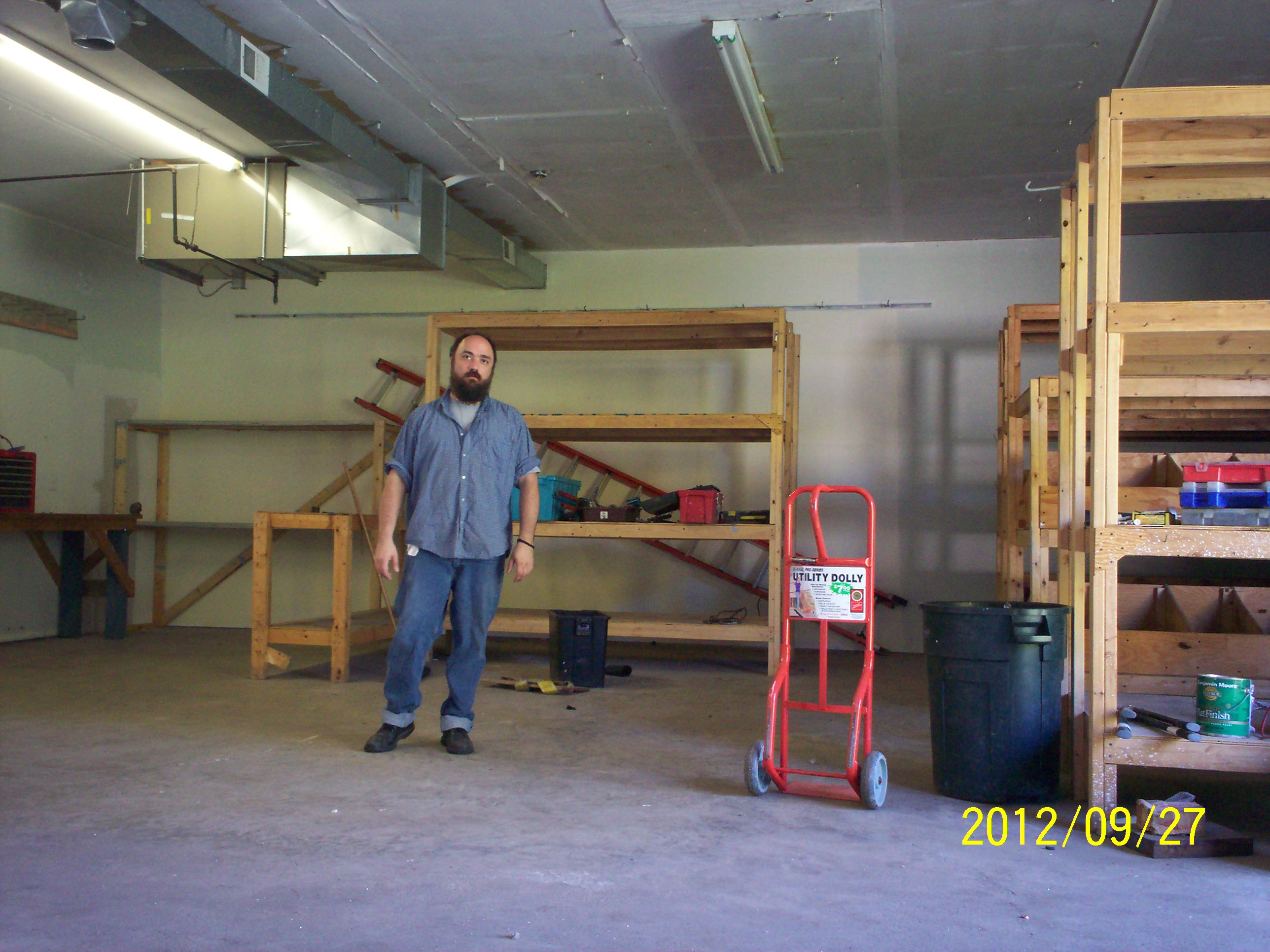
Dismantling the tech center

Dismantling the tech center

The first one was a manual labor job helping to dismantle a cell phone tower installation tech center. The supervisor let us take a some of what was left in the office, so I got a nice leatherette desk chair, some unused sticky notes, a ladder, and a case or two of printer paper which I use for printing poems. I’m not sure what I’ll use the ladder for. From the supervisor, a pompous and unsettling old man from Chicago, I got an interesting anecdote which I wove into a poem I was working on at the time.

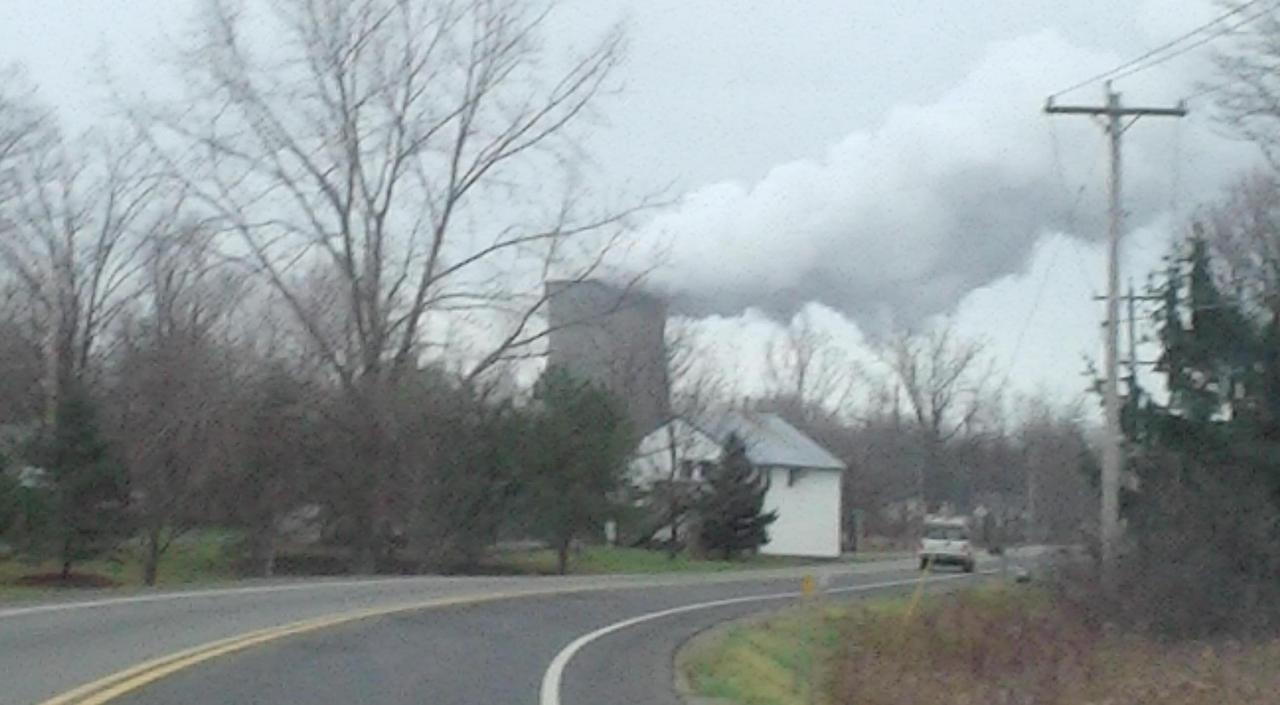
Delivery job - Wampsville, NY

Delivery job – Wampsville, NY

Over this last winter, I worked as a delivery person for a compounding pharmacy, filling in for a driver who’d had a heart attack. I motored all over central New York, making deliveries inside the homes and basements of the very rich and profoundly poor. The only common dominator was that everyone was, or had someone in the family who was, seriously and gravely ill. One minute I’d be in a glittering mansion on the shores of a Finger Lake, and immediately after in a rusty trailer with an obese man with one leg telling me it’s a good thing I don’t knock like a county sheriff. (I made a mental note to be sure never to do this.)

Delivery job - Oswego, NY

Delivery job – Oswego, NY

The view into the homes of my fellow humans here was actually quite moving. I can’t say at all in what ways it has already or might enter my writing, as that kind of thing often takes time for me, if it happens at all. Memories and experiences pop up in poems quite unexpectedly after months and years. And in general I like to write from my sheer imagination, rather than as a form of nonfiction notation. My own penchant for recording the details of my life meant that for most of this delivery job I kept an audio diary while driving between deliveries, and took lots of pictures along the road. I may use these someday for an essay. As far as my poetry goes, I imagine the things I saw (hand guns strewn between cereal boxes on dinner tables, an old lady who couldn’t get out of bed so she kept her bed in the kitchen, charming couples caring for one another as best they can) will find a way in one way or another. If for nothing else, it’s been a serious anti-cynicism aid and a push to maintain the kind of empathy without which good poems don’t really come alive.

Whether or not I’m working I always make it a point to keep writing–and I’m usually pretty good at this. When I have free time, it’s a joy to lose myself in the dream world for days on end. When I am busy working 40-plus hours a week, it’s a way I keep my sense of self and my enthusiasm amid exhaustion and the sadness of using the most productive hours of your day to create things for someone else instead of making poems for yourself.

Though I’m not working in academia these days, I’d ultimately like to return. I miss teaching very much, and rewarding jobs in publishing are thin on the ground here in Syracuse. Of colleges and universities there are a-plenty.

Winter never ends in syracuseIn the meantime, I do whatever temp jobs I can find, hope I don’t get sick (no health insurance)  and write as much as I can. I also make sure to submit my work fairly regularly. Being broke, I haven’t been able to afford to submit my first book to many presses, as they almost all charge, even for open reading periods. But I’ve found a few. And I try to keep sending poems out to journals. I pet my cat a lot. I read. I cook strengthening and nutritious dinners for me and Sarah. I look out the windows and wonder if it’ll ever stop snowing.