Adventures with Poet Christopher Citro

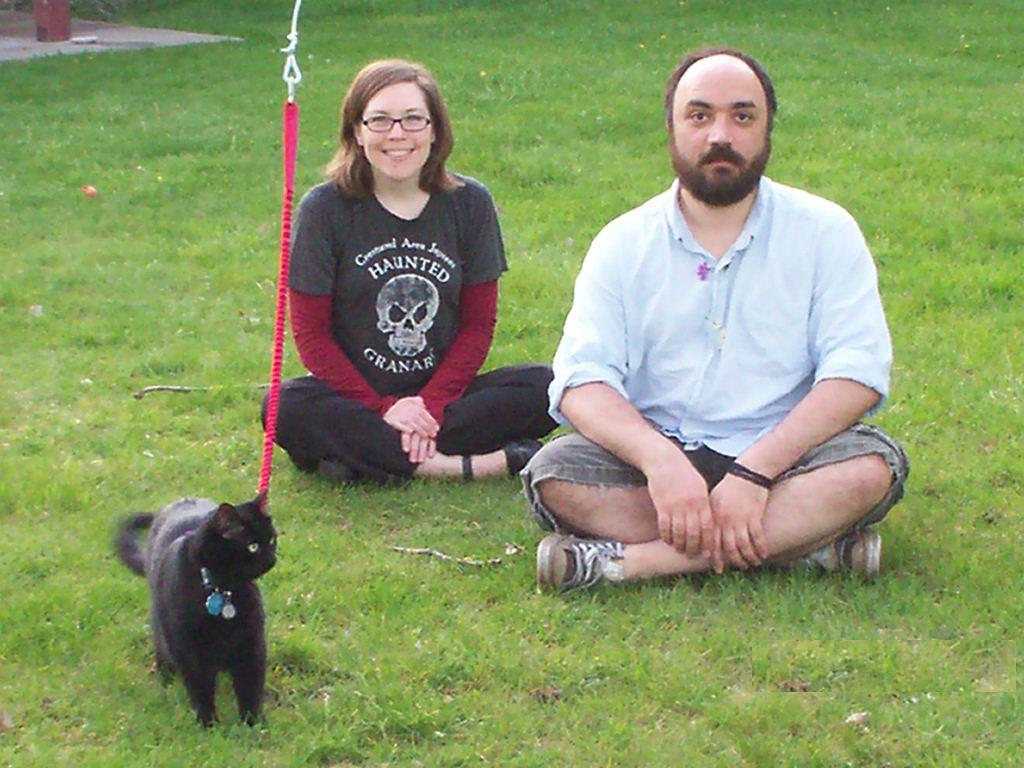
Sarah, Chris and thier cat in the backyard

Sarah, Christopher and their cat in the backyard

I wanted to find a way to celebrate National Poetry Month on my blog,  yet it is April 17, and this is my first post. Luckily, this post is a celebratory one! It contains an awesome interview with Christopher Citro, who lets us into his rigorous writing life and adventurous temp jobs in Syracuse, NY.

Christopher is friend and colleague from Indiana University. I had the pleasure of first meeting him on a road trip from Bloomington, IN for Chicago for AWP. In Chicago, as I remember it, Christopher fortuitously ran into a long-lost cousin on the sidewalk. In all workshops, classes, lectures, and rooms where I saw Christopher again surprising coincidences were often unfolding. On his website you can find his full bio and links to his published works. I encourage you to check it out, because coming to the last line of a Christopher Citro poem is waking from enjoyable dream–you want to linger in the enthralling imagery and emotion, the depth of imagination and humor. One reading, one poem is never enough.

In the following interview, Christopher gives us a snapshot (in words and photos!) of his life and a great deal of insight in to a writer’s life, temp jobs, and empathy as underlying force of poetry.  Interestingly enough, this interview provides a great contrast to last month’s interview with Naoko, and like all the interviews so far, its inspiring. So read on, dear reader!

Can you tell us a little bit about what you write? or how you write? Are there writers you return to or other sources of inspiration you seek out regularly?

I write poems. Or I try to, at any rate.

To speak concretely, I’m currently at work on poems for my second manuscript. (My first, The Maintenance of the Shimmy-Shammy, is still unpublished, but why wait?) After leaving graduate school two years ago, my partner Sarah and I spent five nervous months living off our savings in an apartment above Main Street in a small southern Ohio village near my family while we waited for one of us to get a job to take us somewhere. With nothing but free time–and Amish buggies clopping by at 4 a.m. outside our windows–I thought to myself, if I don’t use this opportunity to get into a serious post-MFA writing groove then I’m a fool.

So I did. I set up a regular morning writing schedule along with my pint of Darjeeling. I sat in a window, listening to Lee Morgan’s 1966 album The Rajah on my headphones, and writing for an hour two each morning. This ended up being one of the most fruitful writing periods in my recent life and produced the bulk of the poems which are forming my new manuscript.

I also made a writing webpage for myself. I debated doing so for weeks, as it felt kind of silly and narcissistic at first, but I’m glad it did it. If you’re not teaching, it can be hard for editors and people to find you. I’ve found that a webpage for my writing has helped me with receiving solicitations and making connections with fellow writers over the last couple years that I don’t think I could have done otherwise.

In addition to Darjeeling tea, and Lee Morgan’s jazz, my other sources of inspiration included the life of the town outside my window, the golden slide of summer into autumn, and a revolving selection of poems which I’d dug out of some of our moving boxes for inspiration. I leafed through recent copies of Indiana Review. John Berryman’s The Dream Songs was a major companion, especially for his speed and sense of rhythm and movement down the page. I started reading the poetry of Matthew Zapruder and Tony Tost, along with old favorites like Wallace Stevens, Jim Harrison, Mary Ruefle, and D. Nurkse.

Since moving to Syracuse, where Sarah eventually found a job, I’ve continued working on my second book, revising the poems begun in Ohio, creating new ones, and listening to the poems as they suggest what shape the book as a whole might eventually take. It’s a rather inchoate thing right now. And I think that’s good for now. My Ohio poems are a pile of throbbing stem cells, only just beginning to specialize into the organs and systems of a new book. And I keep making new ones to add to the heap.

When you write in the mornings for two hours, does that include revising poems, or only generating new material. Do you have  favorite time of day or regimented way to make sure you are sending out your poems to magazines?

The simple answer is: when I’m writing I generally write new poems in the morning and revise/submit at night. Every poem I write is the result of free-writing–an intuitive, unplanned pouring of words onto the page–and I have found that as I get older my brain is more limber and likely to make interesting, energetic leaps if I write shortly after waking.

I’m sort of always revising: in my head with new poems or poems I’ve been struggling with, in the margins of my handwritten journal where I write my first drafts, while typing the handwritten drafts into my computer, with printouts taped to the wall, or when I open poems up on my computer throughout the day.

When I’m in a writing groove, which is most of the time, after Sarah goes to sleep I’ll spend an hour or two or more revising and sometimes submitting. I’ll spend time working on my submission spreadsheet, researching new journals, revisiting old ones, looking for submission calls, reading online journals, reading book and journal reviews, and just generally splashing around in the rich digital waters of contemporary literature. Then when my fingers get all wrinkly and waterlogged, I turn everything off, pour myself a nightcap and read from a book of poems or whatever novel I’m in the middle of. To an outsider, this probably looks like obsessive behavior. To me, an insider, it’s clearly obsessive behavior. And I love it.

What do you do besides write (to pay the bills)? How did you end up doing that? and how does it influence/interfere/inspire your writing life?

If I were on my own, finance-wise, I’d probably be in the gutter, or curled up muttering in a fetal position in a loving family member’s attic. Since finishing my MFA program, I’ve been largely unemployed. Thankfully, I have a caring and generous partner who has a good job which more or less keeps us and our cat in Tender Vittles, chicken thighs, and whisky. I have very few expenses and have stripped down what I need to live to the bare minimum. Living as a graduate student helped this process, but living even broker subsequently has really tightened things.

Job-wise, upon arriving here, I signed up at half a dozen local temp agencies which have found me a total of two jobs for two months in the last year.

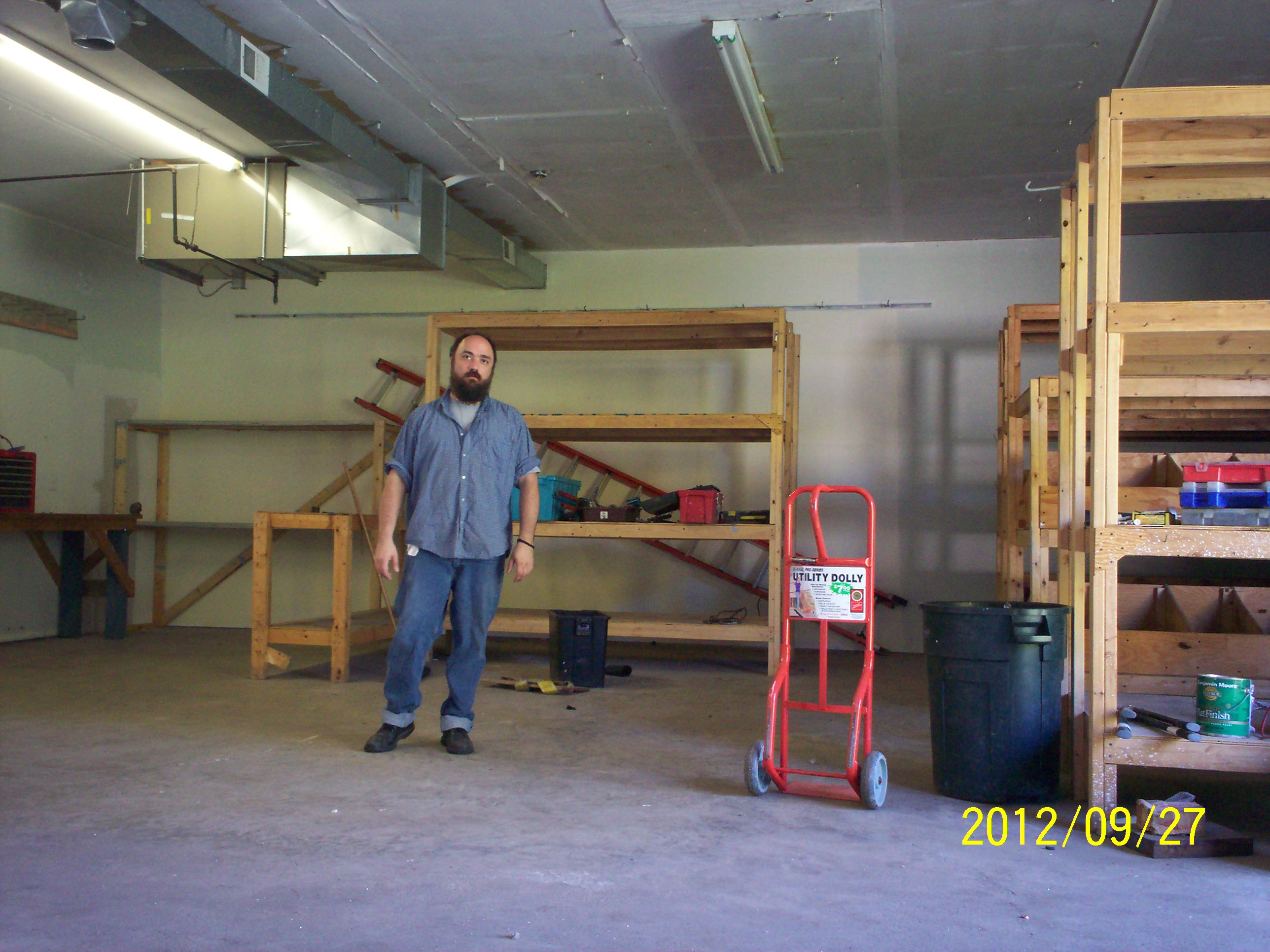
Dismantling the tech center

Dismantling the tech center

The first one was a manual labor job helping to dismantle a cell phone tower installation tech center. The supervisor let us take a some of what was left in the office, so I got a nice leatherette desk chair, some unused sticky notes, a ladder, and a case or two of printer paper which I use for printing poems. I’m not sure what I’ll use the ladder for. From the supervisor, a pompous and unsettling old man from Chicago, I got an interesting anecdote which I wove into a poem I was working on at the time.

Delivery job - Wampsville, NY

Delivery job – Wampsville, NY

Over this last winter, I worked as a delivery person for a compounding pharmacy, filling in for a driver who’d had a heart attack. I motored all over central New York, making deliveries inside the homes and basements of the very rich and profoundly poor. The only common dominator was that everyone was, or had someone in the family who was, seriously and gravely ill. One minute I’d be in a glittering mansion on the shores of a Finger Lake, and immediately after in a rusty trailer with an obese man with one leg telling me it’s a good thing I don’t knock like a county sheriff. (I made a mental note to be sure never to do this.)

Delivery job - Oswego, NY

Delivery job – Oswego, NY

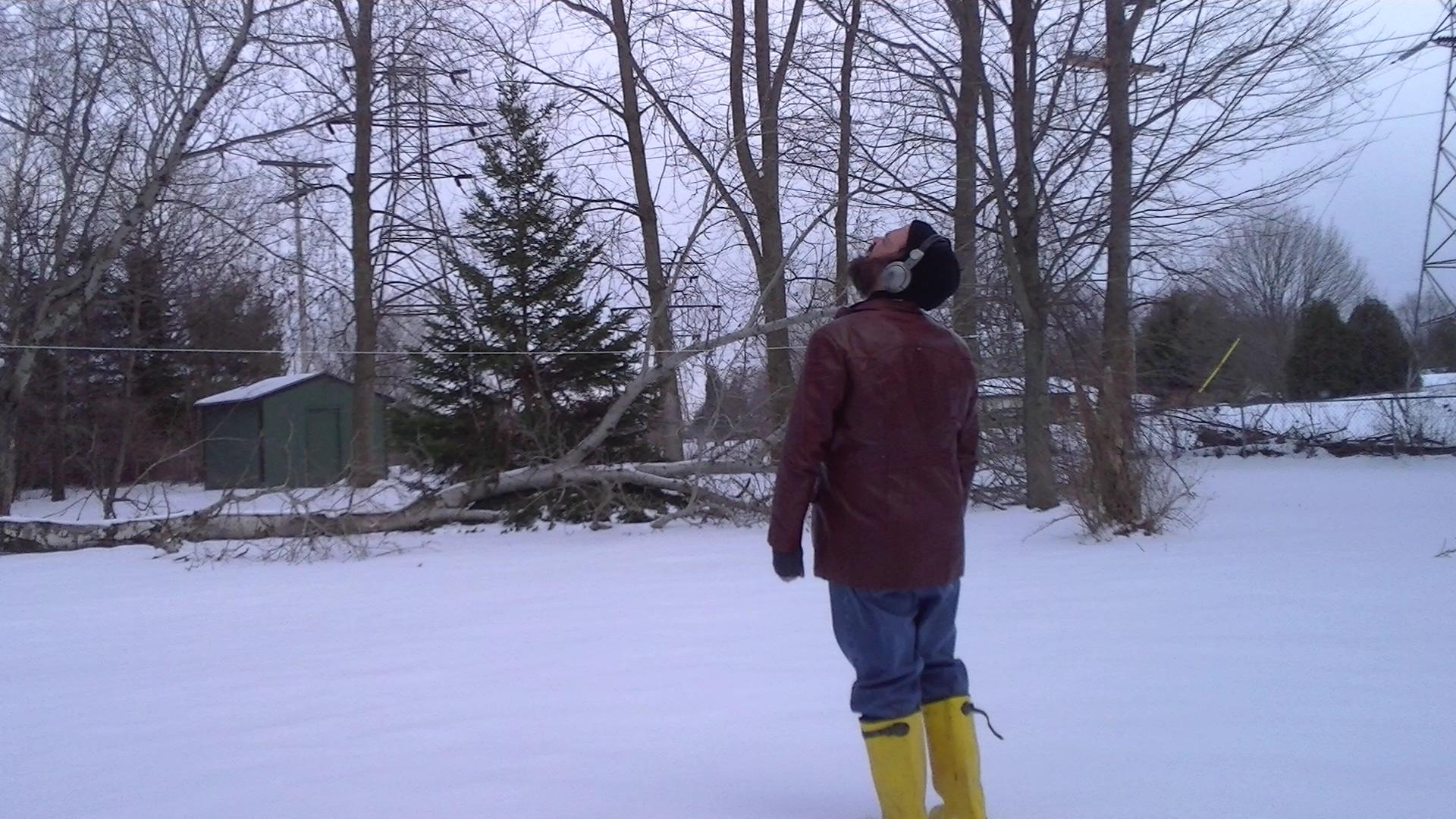
The view into the homes of my fellow humans here was actually quite moving. I can’t say at all in what ways it has already or might enter my writing, as that kind of thing often takes time for me, if it happens at all. Memories and experiences pop up in poems quite unexpectedly after months and years. And in general I like to write from my sheer imagination, rather than as a form of nonfiction notation. My own penchant for recording the details of my life meant that for most of this delivery job I kept an audio diary while driving between deliveries, and took lots of pictures along the road. I may use these someday for an essay. As far as my poetry goes, I imagine the things I saw (hand guns strewn between cereal boxes on dinner tables, an old lady who couldn’t get out of bed so she kept her bed in the kitchen, charming couples caring for one another as best they can) will find a way in one way or another. If for nothing else, it’s been a serious anti-cynicism aid and a push to maintain the kind of empathy without which good poems don’t really come alive.

Whether or not I’m working I always make it a point to keep writing–and I’m usually pretty good at this. When I have free time, it’s a joy to lose myself in the dream world for days on end. When I am busy working 40-plus hours a week, it’s a way I keep my sense of self and my enthusiasm amid exhaustion and the sadness of using the most productive hours of your day to create things for someone else instead of making poems for yourself.

Though I’m not working in academia these days, I’d ultimately like to return. I miss teaching very much, and rewarding jobs in publishing are thin on the ground here in Syracuse. Of colleges and universities there are a-plenty.

Winter never ends in syracuseIn the meantime, I do whatever temp jobs I can find, hope I don’t get sick (no health insurance)  and write as much as I can. I also make sure to submit my work fairly regularly. Being broke, I haven’t been able to afford to submit my first book to many presses, as they almost all charge, even for open reading periods. But I’ve found a few. And I try to keep sending poems out to journals. I pet my cat a lot. I read. I cook strengthening and nutritious dinners for me and Sarah. I look out the windows and wonder if it’ll ever stop snowing.
Naoko Fujimoto: poet, artist and the Japanese machine industry

I met Naoko at a poetry reading in an Irish pub in South Bend, IN. After the reading, we learned that we both lived in Chicago and decided we should meet in Chicago next time and save ourselves the two hour drive. She is a dazzling poet and in this interview shares a lot of insight into a writer’s life. You can find out more about Naoko and her writing and art on her blog

Naoko 021513 D

But first a little bio: Naoko was born and raised in Nagoya, Japan. She came to America as an exchange student at Indiana University South Bend. There, she received a bachelor’s and master’s degree in English. Currently, she works as a sales assistant in the Japanese machine industry to support her artistic pursuits.

Tell us, what do you write?

I write poetry and personal essays. My poetry is currently focused on the Japanese earthquake and following nuclear disaster. Before the earthquake happened, my focus was on war. My grandfather was in the navy in Hiroshima during World War II. He was a very quiet person; however, once a while, he rushed to speak about what he saw when the atomic bomb exploded. As Japanese poet, I have a passion to preserve how people live through those ongoing obstacles.  For my personal essays, I used to be a columnist in Indiana University South Bend’s college newspaper. The column series was called “Empty Suitcase.” The essays were about how an Asian exchange student survived American college life with a fork & knife over chopsticks. You may wonder, but they were not food critiques— though— I wrote about twizzler-astic experiments. Now I occasionally write personal essays for my blog.

Can you share a little about your writing process? 

I write everyday with a pen & paper and on the computer. My very first draft is written with both Japanese and English mixed in a notebook. I carry the notes everywhere like a yellow comfort blanket— just like a Linus from Snoopy. Once I am ready to formally write down a poem, I type it in English. For the final process, my husband proofreads my poem. He is a full-time industrial editor; however, we sometimes fight over his word choices, fixing former grammar, and comma rules. I scream, “You are destroying my poem!” even though he is right.

Who are the writers you return to for inspiration?

I like reading traditional literature and philosophic science articles in Japanese. Soseki Natsume (famous Japanese writer, 1867-1916) and Takeshi Yoro (doctor of anatomy at Tokyo Univ., 1937 – current) are my favorite authors. Natsume’s writing is funny in a kooky way even though he is writing about death. His sense of humor is like a ray of light in life. His writing teaches me that I cannot forget “hope” even though I am writing about tragedy. I read Yoro’s books when I need to think outside “common” sense. When I write a poem, I should be very flexible in American, Japanese, and other cultures. I want to write something that I can only create.  I also like “Firstborn” by Louise Glück, “Rose” by Li-Young Lee, “Internal West” by Priscilla Becker, “Rising” by Farrah Field.

So tell us more about being what you do for a living. 

I work as an inside sales support and translator in a Japanese-American company. I graduated in a horrible economic situation. All my college friends, including my husband, had really difficult times finding a job. Fortunately, I found a job through a Japanese agency and was hired.  For a long time I doubted my decision— should I be a starving artist?— However, I concluded that it is very important to have a secure environment financially and emotionally. It has been three years since graduation and I am finally happy where I am in my life.

However, it is tough to keep working in an office environment for artists or anybody; even though, I am paid with benefits. When I am upset, I try to think that I am in a business school with a full scholarship and allowance. I actually have learned a lot about business manners and rules— how to communicate with customers, decide work priorities, and have presentations with clear pronunciation! I am really thankful for my bosses. They understand my artistic characteristic and deal with me.

That business knowledge will help me when I become an established poet later.  Currently, I do not have any books; however, I want my readers to be happy when I sell my books. I would like to read my poems with proper pronunciation. And most importantly, I would like to entertain people through my art.

I recently opened a little art shop on Etsy.  I draw with soft pastels and colored pencils along with my poems. In addition, I am thinking to have a poetry and music reading concert again with a Russian-Estonian pianist sometime in the spring. We had a poetry concert about the Japanese tsunami last June in South Bend, IN.

For my dreams, I would like to create a poetry-musical-concert-theater-reading. I do not know how I am going to create one, but it is super-fun to think about that!

Thank you for sharing this insight and inspiration, Naoko. A mix-media art night sounds awesome. Keep up posted on this dream! 

I think Naoko makes an important point about whether it is nobler to be a starving artist or to create a stable, financially responsible lifestyle for yourself. Virginia Woolf weighed in on this conversation in A Room of One’s Own when she wrote, 

All I could do was to offer you an opinion upon one minor point – a woman must have money and a room of her own if she is to write …

I tried to Start a Twitter Revolution

Before Christmas, I heard this story on WBEZ, the local NPR station in Chicago. The images of pain and injustice haunted me over the holidays; I couldn’t believe something so outrageous and inhumane could happen so near to me. {I advise listening to the story, but here’s a brief summary: A temporary worker (who worked at Raani Corp for 10 years) was terribly burned by chemicals, denied immediate help by his supervisor, and a month later died of his wounds.}

In January, I heard a follow-up news piece saying that Raani Corp denied any wrongdoing and blamed the temporary worker. A righteous fire lit up inside of me. I wanted to make sure I didn’t buy any products made by Raani Corp so I looked up their website http://www.raani.com/ . In the story of the growing business I learned about the CEO Rashid Chaudary. I learned that K-mart and Jet Magazine and Ebony Magazine, among other companies that are not named, have hair and/or other self care products made at this factory located just outside of Chicago’s southside.

I learned the name and email addresses of some of the officers of the company.

Dr. Eugene Frank 
Sr. Vice President, Sales & Marketing
genef@raanicorp.com
Denise Swiecicki
General Administrative/Customer Service Manager
denises@raanicorp.com
Pervaiz Jafri
Director, Quality Assurance
pervaizj@raanicorp.com


97228-v1

I found a picture of the CEO’s 12-bedroom house. And I tweeted it, and I tweeted all of my other findings. I tweeted all of my outrage. I tweeted @KMart, I tweeted @EbonyMagazine and @JetMag. I tweeted and I tweeted, and no one seemed to noticed. No replies, no re-tweets.


So I wanted to think about what I did wrong with my twitter revolution. Here are some ideas:

  • Perhaps, I tweeted too late at night. I was tweeting between 8-10 pm. However, according to this study that is the best time to tweet. However, many of my followers are in different time zones? 
  • Perhaps my tweets weren’t catchy or strongly worded enough: I wanted to be accurate and my tweets got lengthy. Perhaps, I needed to rely on a hook and link my fellow tweeters to the accurate information.
  • Maybe its harder to start a twitter revolution than I thought. I need to get @NickKristoff to follow me and re-tweet me.

Do you have any advice on how to start a twitter revolution?  I hope you will listen to the WBEZ story and share my outrage with me.

5-9: Abdel Shakur on fiction, 9th grade, and patience

Abdel and his daughter, setting up his classroom.

Abdel and his daughter setting up his classroom.

Happy New Year! I’m excited to post today’s interview with Abdel Shakur. I heard about Abdel long before I met him. At Indiana Review, he is the editor who brought you the unforgettable funk issue in 2008. I got there a year after he had moved on to bigger and better things, but the office was still feeling the glow of that issue. Recently, he was kind enough to carve out the time for to correspond with me about the writing life. Abdel’s work has appeared in 2bridges, Glint, and Scissors and Spackle. And you can find him blogging at misstraknowitall.blogspot.com. He lives in Chicago with his family and teaches ninth grade English.

AS: Who are the authors you return to for inspiration?

James Baldwin the most. He’s an awesome role model for purposeful artistry and purposeful living. He’s not perfect, but you got to learn to love your imperfections.

AS: How does teaching influence/inspire/interrupt your writing?

I think one of the biggest insights I had as a teacher is how important it is to present yourself to your students as a model of thoughtful creativity. If I want kids to think, I have to show them how I think. If I want them to read critically, I’ve got to model it. If I want them to be writers than I have to make sure I’m still a writer myself. Of course that’s easier said then done, but I write all of the projects I ask my students to do, which motivates me to want the writing to be as fun and interesting as possible. I also started taking the train to school, which gave me time in the mornings. But this is the first year I could write like that. This is my fifth year of teaching and I feel like I pretty much know what I’m doing. Instead of directing all my creativity to creating projects and worksheets, I try to do a little on my writing every day. Starting that up again is one of my big goals for 2013.

AS:  That’s awesome that you write all the assignments that you give your students. Have any of the assignments turned into a full fledged story for you? Do any of your stories ever take place in fictitious class room? Or do you usually leave the classroom behind when you are writing?

I can’t say that any of my class writing has turned into anything I’d really like to work on further. The stuff I write for class displays a part of my writing, but a lot of the stuff I write isn’t necessarily school-appropriate. I just published a story, The Substitute, in 2 Bridges Literary Review that was influenced by my experience working in a school in Baltimore. It’s one of those class-from-hell experiences.

I’ve also written a bit since then about school stuff, but it’s kind of hard when you’re still immersed in that world to find the distance you need to examine what’s going on. Plus, with a lot of journals being available online, you’ve got to be careful because people have certain expectations about what teachers can and cannot write. Although I love teaching high school, that’s one of the real drawbacks.

I’m grateful for Abdel sharing his thoughts on what its like to be a writer and ninth grade english teacher. I also feel encouraged by his words of wisdom about patience and by the integrity he models for his students. He’s taking the do-what-I-do approach instead of the do-as-I-say-not-as-I-do approach which often is the easier way.

As this new year continues to roll forward what are your big goals of 2013?

5-9: Angela Narciso Torres, poet, mother, editor

I was lucky to meet Angela Torres at the Poetry Foundation here in Chicago during a poetry reading honoring Lucille Clifton. It was a magnificent evening–the kind of poetry reading that leaves you energized and feeling like everything is brimming with potential. During the wine reception, I sat next to Angela and bumbled over some words while trying to balance a plate of cheese and crackers on my lap. I think I asked her if she was a writer, and she said, Yes, a poet. And then, I asked some awkward question like: What do you do to be a poet. She responded graciously, I write.

This meeting is what sparked the idea to create this series of interviews with poets living and working in the real world. What does it mean to be a writer, a poet? and how does one go about it? Angela agreed to be interviewed, and I think you will agree with me, her thoughtful answers will inspire you to go to your desk and write.

319298_2263232213979_1193589406_n-1First, a little bio: Angela Narciso Torres completed her MFA from Warren Wilson. Her recent poetry is available in the Baltimore, Cimarron, Collagist, Colorado, Crab OrchardCream City, and North American Reviews, and in A Face to Meet the Faces: An Anthology of Contemporary Persona Poetry. Her poetry manuscript was a finalist in the Crab Orchard, Philip Levine, Brittingham/Pollak, and Idaho Poetry Prize contests. A recipient of an Illinois Arts Council grant, she serves as an editor for RHINO.

AS: Who are the authors you are likely to return to for inspiration? Why?

AT:
  • Jack Gilbert for his ability to sing despite the brokenness of the human condition. See, for instance, his poem “A Brief for he Defense” from his book Refusing Heaven.
  • Sharon Olds who is a master at metaphor-making and who speaks with incomparable clarity, beauty, and truthfulness about the body, the family, being a woman in various roles (mother, daughter, writer, self) without privileging any one over another.
  • Donald Justice because his poems teach us to stand on traditional forms while making them new, and for the melancholy beauty and musicality of his writing.
  • Yusef Komunyakaa for how his work draws directly from experience yet somehow transcends it to create something totally otherworldly through rhythm, sound, and image.
  • Li Young Lee for the spirituality that infuses his writing, and for his use of white space and breath to invite the reader to participate in meaning-making.
AS: What sort of work do you do outside of writing? And how does it influence/inspire your writing?

AT: I help edit RHINO magazine and raise my three boys.

As a writer, I consider it one of my greatest fortunes to be associated with RHINO magazine. The editor-poets I’ve met there are some of the most genuine and generous individuals I’ve ever met. Knowing them helped me gain a sense of connection in the larger Chicago writing community when I moved here 5 years ago. Some of these editors have helped me invaluably in my poetry writing through a poetry critique group in which we exchange and comment on each others’ work. It’s also been very instructive to be on the receiving side of poetry submissions, and humbling too, to see not just the immense talent but also the sheer volume of poetry being written out there.
Though I’ve always been drawn to writing, I like to think that becoming a mother was the main impetus for my beginnings as a serious writer of poetry. When my three boys were under the age of five, I found writing poetry to be a means of carving for myself a sacred space, a room of my own, so to speak. Yet it was the constant tug of daily life that kept me grounded and allowed me to soar with my imagination during the quiet moments–between feedings, during naps, and later, while waiting in the car during piano lessons or soccer practice. In the midst of parenting I learned  to develop the solitary discipline necessary for a writer’s life.  When they got older, I started attending more writers’ workshops and conferences and eventually pursued an MFA through the low-residency program offered by Warren WIlson. But without the constant demands of parenthood on my time and energy, and also without the rewards of raising these wonderful curious beings who saw the world with such freshness and wonder–I don’t think I would ever have found my way into writing poetry.
AS: “The solitary discipline necessary for a writer’s life.” Well said! I am still working on learning how to develop that, but just hearing you speak about it makes me wants to write.
You can read a few of Angela’s poems here, here and here and learn more about her writing process by reading another interview with her here.
If you were inspired by Angela’s discussion of what its like to be involved with a literary journal, consider getting to know a journal near you. I just learned about Journal of Ordinary Thought published out of Chicago’s Neighborhood Writing Alliance, a social justice and writing organization and am hoping on getting involved in their editing stages.
All literary journals are labors of love and can often use another intern, proofreader, editor, or subscriber, so go, get connected.

5-9: Ellis Felker, poet and owner of Red Oak Publishers

I am excited to post the interview of the first contributor to my blog series 5-9 which asks poets and writers who are working outside of academia what they do and how they do it. With this series I hope to create a place of dialogue for writers pursuing their craft away from the ivory towers.

I live for the colors of the morning! — Ellis Felkerellis-felker-2012

Ellis Felker is a poet and owner of an independent greeting card company. He is the author of several volumes of poetry which he published through his company. I recently asked him a few questions about his writing and his career.

Alessandra Simmons: What do you write?

Ellis Felker: I write daily journal entries, poetry, short essays and dreams.

AS: Who are the authors your are likely to return to for inspiration or other sources of inspiration?

EF: Depok Chopra and Henri Nouwen.
AS: I’ve also enjoyed reading Henri Nouwen. When did you first read him? Do you have a favorite title?
EF: I first read Henri Nouwen about thirty years ago when my printer was publishing a little book of his. My favorite title is: The Inner Voice of Love. I am now reading a short biography of his called : Genius Born of Anguish. Poor Henri. He never overcame his harsh Catholic upbringing. And he never embraced the fact that he was gay. He clung to the Church until the bitter end.
AS: Tell us more about the work you do outside of writing. 
EF: I own a greeting card company called Red Oak Publishers. I edit art and take photographs for the company. I also do marketing and sales.
AS: Owning a card publishing company sounds like creative and all encompassing work. I’m intrigued. How did you come into that kind of work?

EF: I started my card company 31 years ago. I was taking great photographs and I wanted to share them with the world. I always would rather sell one hundred photos at a dollar each than one photo at one hundred dollars. Again, I had my own vision and I could find no publisher who shared that vision. Out of nowhere I inherited some money. That was the seed money for my card company. I had a vision and a destiny to fulfill and I knew that only I could do it.

AS: What is the most rewarding part of the job? What is your least favorite part?

EF:  The most rewarding part of my card company is taking or finding new images that sell to the public. And that move and influence them. I love selling the card I shot of an archway in Ireland. It is a sympathy card that I have probably sold 10,000 of. I also love the printing of new cards on my printers new digital press. The worst part of my job is all the business and marketing and constant selling. It sometimes fries my poet’s brain! Luckily I have a very good sales director who helps me. Without him I could not run this thing.

AS: How does your profession influence/inspire/interrupt your writing or How do you manage your writing life alongside your professional life?

EF: I blend the two together as much as possible but running my own card company can get mentally overwhelming at times. I sometimes feel split between poetry and business.  Yet some of my writing does end up on my cards. It is still all “me” afterall.  I do wish I had more time to write but that will have to wait a few more years when I sell my card company. I hope I will be “freer” then!?!

AS: Tell me, how did you decided to go the self-publishing route? 

EF: [My poems] are all self-published. I started my own publishing company because I couldn’t find another publisher to publish me. And I felt I could have more control if I published my books myself. Greeting cards too. All I had to do was to come up with my company name (Red Oak Publishers) and hire a printer. Pretty easy. No rejection. Total control.

AS: That sounds great that you can use your writing in your professional work. Can you share an example?

EF: My all-time best selling card (about 30,000) has a photo I took of one of our kittens and below it my words that say: I once asked a four year old what the secret of life was. “Feed the kitties,” she said. “Feed the kitties.” A true story!

AS: Thanks Ellis! I love hearing about your career and writing. It takes a lot of thought and faith to start your own company! Thanks for sharing your story with me and the readers of this blog!

A Time for Form

So I’ve never claimed to be a formalist. I’ve tried my hand at sonnets and ghazals, but I often prefer to invent new forms for each poem. But the other day I was trying to write a poem whose content needed to be returned to again and again. I wanted a looping effect. I tried that organically, but it wasn’t working. Then I turned to the good old villanelle and the cycle, repetends all a landed perfectly (a few hours of wrangling later).

Which again leads me to think that all forms no matter how old, common, rare, or structured are organic for certain occasions.

In my freelance writer life, I’ve been writing ACT-like English passages that must have certain errors, subjects, lengths, alternatives (answers), and spacing. The work of writing these feels so similar to piecing a puzzle of poetry together. When I complete a passage, there is that satisfaction of accomplishment. MFA skills translating into the paying world. I also feel a certain amount of guilt for creating new material with which to torture poor high school students.

Enjoy this link to the english languages most popular villanelle. One Art by Elizabeth Bishop

A list of nonsequitors

1. We had our first successful tutoring session on at Washington Park Field House. It was all things working for good that brought one student and her little brother with a folder full of homework. We analyzed a poem and brainstormed an essay on identity. It was delightful. It was pulled off by no means of our own. It was poorly planned (finding a location was difficult), poorly advertised (text messages sent to students) but it worked out better than I hoped it would. Next week, if text messages are followed through on, we should be expecting 3 students! Baby steps.

2. I had a dream last night I sold my heart. Even though I knew this would kill me. It was in order to avoid a worse death in a Nazi like state that was coming soon. However, when the date came closer, I realized I wanted to live. I went to the butcher to find a substitute. However, the butcher only had light pink animal (pig or rabbit) hearts. I took the biggest one with hopes of dying it a darker more human red. The heart in my dream were vivid and disconcerting. The person who I had promised my heart to called and asked if he could have it a week early. It was for his pregnant wife. No. No. I said, you can not have it early. I was still working on the disguise. I thought to myself, I have money. I can buy a plane ticket to the U.S. when they find out its not my heart, that I’m not dead, and before the Nazi party seize power.

3. Every day with 2nd and 3rd graders is going to be different. Prepare and expect something unexpected to happen.

4. My sister, Sonnet, had her EP release concert last weekend. Go buy it on itunes. It’s phenomenal. Everyone who was lucky enough to be in attendance said she killed it. But you don’t have to take my word for it, if you think I am biased. Interview with Sonnet on HuffPo here. Anthems, dance tunes, ballads, pop songs with thought. She proves its possible to have it all, with grace and heart.


Good Intentions do not make a space.

So R. and I decided it would be a good idea to tutor some of the students who we had been volunteering with at Green Youth Farm. R. gave an inspiring talk about college admissions process, it revved everyone up to get ready. We decided Sunday afternoons we would head down to Washington Park to have some tutor sessions. Students could bring HW questions, essays they were working for class or college admissions or have R. help them study for the ACT. Simple as that. Students wanted tutoring. We wanted to tutor. But then it occurred to us, we needed to BE somewhere while doing said things.

The libraries are closed on Sundays. We emailed the Park Field house contact. I visited the Field house, wrote a note; I called churches. I visited the cultural center and emailed the director. I showed up on churches door steps ringing doorbells. At the baptist church, they laughed, Oooh, We are too full on Sundays. No room. Although, they didn’t ask for the details that I wanted a room for only about 10-15 people in the afternoon. I tried to slide my details in between their excused, but I could tell they were not interested. Try the Catholic Church across the street! They used to be a high school.

That sounded promising. I crossed the street, I walked to the courtyard. It was silent, but for the wind churning the dead leaves. A statue of saint, face tilted toward heaven, hands in prayer stood alone in the courtyard. I walked around until I found the church office doorbell. An old nun with drooping eyes, and a limp answered. Yes. I told her my plight. A room, just one sunday a month, maybe two. Oh, we don’t have any students here, we had to close the high school. I explained that we had the students, we had the tutors all we needed was room. Oh no, oh no. I don’t think so. Someone would have to clean the room, the bathroom, light the boiler. I offered to clean the bathroom, and wouldn’t the boiler already be lit on Sunday? Maybe. Call Father R. But I don’t think so. 

I called Father R. the next day. He also was uninterested in hearing the details. But gave a litany of excuses. If we rent out the building we won’t be able to offer it anymore. 

So R. and I are meeting at Starbucks which has room enough for us, but even it is not quite as close to the high school as we were hoping to be. I hope students come on Sunday, but not too many.

Perhaps it was unfair to expect people to offer us a free room. But I was quite irritated and mostly disappointed by the attitude of the church representatives I spoke too. One church was too full of Christian activity to make room for a few high school students. The other one too empty.

I suppose we went about this all wrong. In my previous experience I had been living in the area where I wanted to be of some kind of use, give some kind of service. So I had more connections with the people in the neighborhood and might have known who to ask. We will see.